Parsley Worm and The Butterfly it Becomes

Screen Shot 2017-04-20 at 1.55.56 PMThis is a story about the parsley worms in my backyard. My garden is small, and a bit unique in that at the present time my vegetables are in pots and fabric bags.  I use fresh parsley often, and I have it growing in two locations.
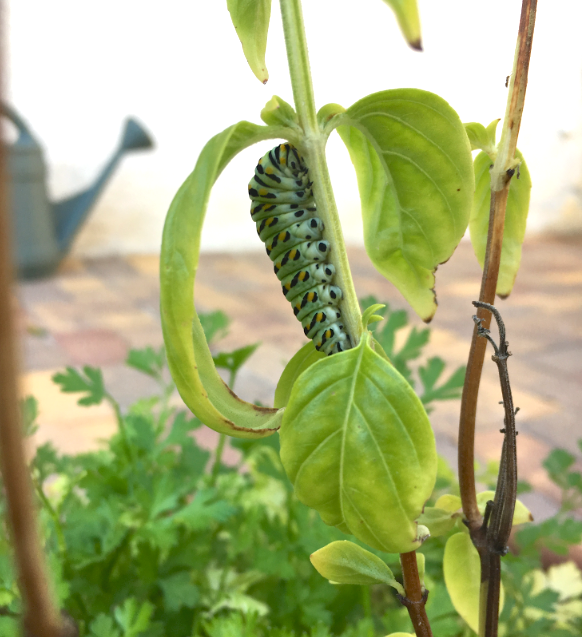
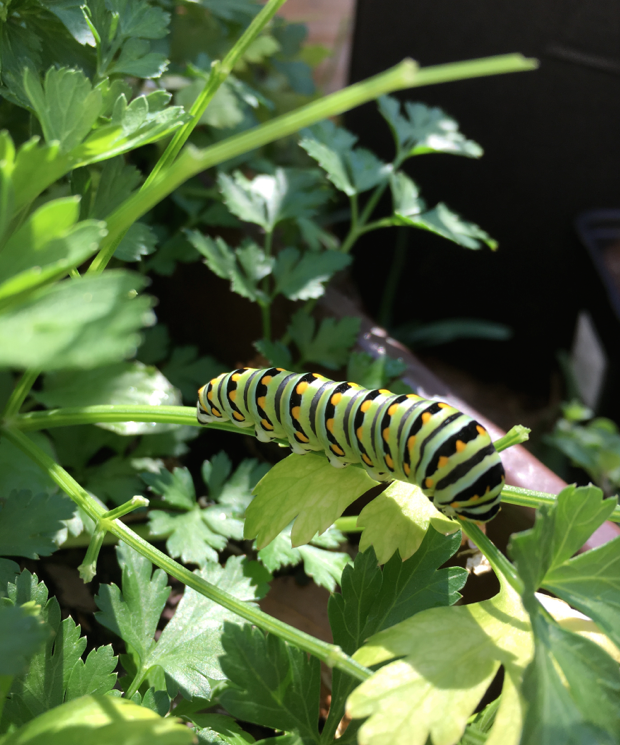
One day I found this colorful worm crawling along a parsley stem and munching away.  I could see that he had chewed off many of the surrounding leaves.  This striped guy is appropriately called a “parsley worm”.

I couldn’t remember what type of butterfly it would become, (had to look that up) but I knew it was getting ready to form a chrysalis.

Turns out it’s a Swallowtail butterfly that emerged from the green chrysalis a few weeks later. The wrapped worm was attached to a stem of basil, which had gone to seed, but was in the same pot as the parsley the worm was eating.

But here’s what happened first.  I found the worm sitting in this position (below) and he was no longer eating.  In fact he was on the basil now, and not the parsley.  This is where he formed his chrysalis.  I checked it every day, and after a few weeks, there was something new to see.

Screen Shot 2017-04-20 at 1.58.07 PM
Worm beginning to form a chrysalis

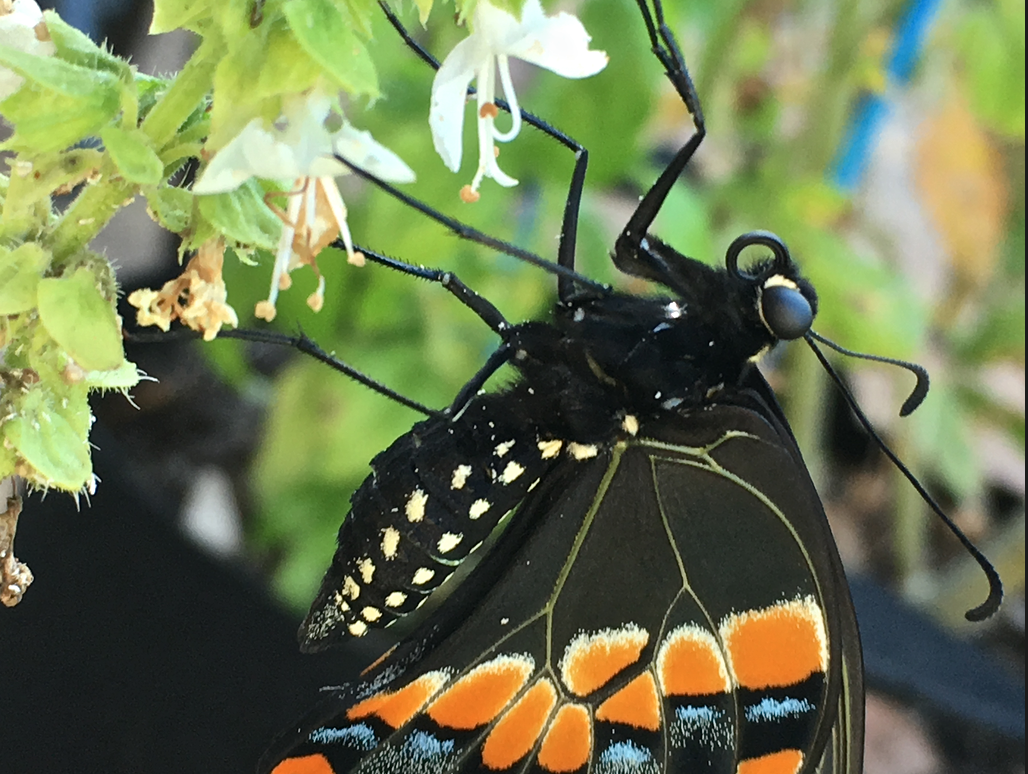
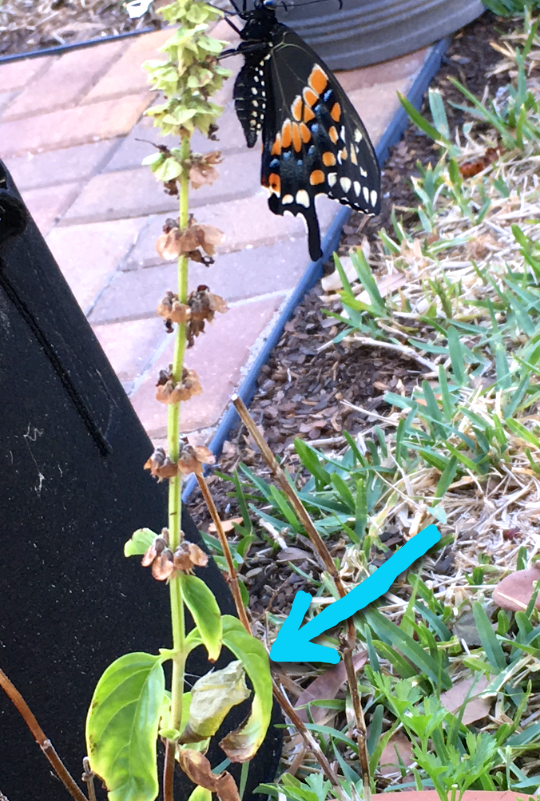
Once the butterfly “hatched” he crawled to the top of the basil stem to try out his new wings.  Maybe this is the perfect set up for encouraging butterfly production.  I hope it happens again.

Screen Shot 2017-04-20 at 2.34.44 PM
Arrow pointing to the empty chrysalis

A few days ago I happened to go outside and saw this beautiful black butterfly at the top of the basil stem, and I knew… the baby was born!  The wind was blowing, but he held on for hours.  I kept checking on it, and then suddenly he was no longer there.

I felt like a proud parent.  I had helped a new baby butterfly enter the world. Course, I had done nothing but plant the parsley… haha!!!  But I felt good. And I’m glad I was able to see the beautiful butterfly before it flew away.  I took lots of photos, like a proud parent does, and one video.


It turns out that there are many types of Swallowtail butterflies, and the worms can be different colors too.  I honestly don’t know much about all of this, but I love it!  Imagine going from being earth bound and crawling among bunches of green parsley, to having big beautiful wings that take you up into the sky!  I will keep an eye out for eggs on the parsley leaves, and bright green worms among the branches.


Wondering When my Persian Lime Tree Will Bear Fruit

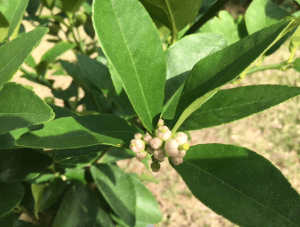
Persian lime buds
Buds on the Lime Tree

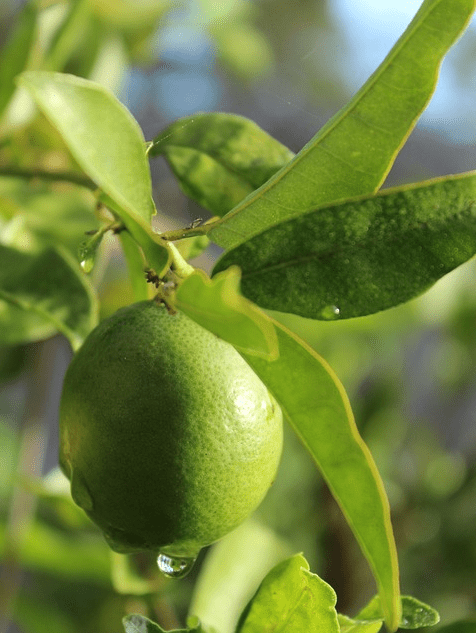
A few months ago I purchased a lemon tree and Persian lime tree from a local nursery. Both are blooming and beginning to bear fruit. I planted the lemon tree in the ground, but decided to keep the lime tree in the pot. I’m glad I wasn’t in a hurry to put them both in the ground, because the lemon tree is not doing as well as the lime.

The Meyer lemon began budding almost as soon as it was planted. The tree itself is very small, so I expected no fruit from it. Surprisingly, some of the lemons are now getting to a good size, but many have already fallen off. I gave it a sunny spot, but failed to realize the amount of wind the tree would receive. The lime is more sheltered from the strong wind, on the south side of the house, and also gets a lot of sun.   From what I’ve read, this is more to it’s liking.  

budding persian lime tree
Potted Persian Lime Tree

Also, the lime tree (photo above), which was never removed from it’s original pot, began to grow like mad! It has doubled in size in the past few months, and is just now blooming. Because of the size, I have some hope of picking limes in the not too distant future.  Fingers crossed! I’m holding of putting it into the ground because it’s growing very well where it is.

Because I am not familiar with growing either types of fruit, I searched online for Persian Lime Tree Care and found an article at the Gardening Know How site.  In fact they have many articles with growing and care information.  That being said, I always get my gardening information from more than one source – especially when reading online.  In fact, this article “How Long Does it Take to Grow Limes?” at the Home Guides site, gives a lot more useful information.  It tells me that fruit is harvested twice a year; May-June and November-December.  This is the information I wanted to find.

Online articles can be written by experts, or by people who really have no idea what they are talking about.  Some people write online simply to make money and are not all that interested in truthfulness.  I prefer to find information on a blog written by someone with first hand experience.  In other words, someone who cares enough to share what they know to be true.

At the present time, I am not a lime growing expert, but I hope to become one by growing them myself.  As time goes on I will share MY first hand experience, but for now, I must count on others for solid information.

I’ll be sure to post about eating my first home-grown lemons and limes!

Happy Easter

It’s Easter 2017 and I have worked online most of the day. We have no special food to eat, just leftover chicken from yesterday. It’s not a big deal here. I know what Easter is all about and I used to spend the morning at church, the afternoon eating, and the evening cleaning up. I hid Easter baskets, and worked hard leading up to this day. I know that Jesus rose from the dead and it’s a wonderful thing, but I just don’t celebrate as I used to.

And it’s nice. Hope you had a nice day.

Hydrangeas in Florida May Grow Best Inside

With the extreme heat and sun of Florida, it may be best to grow hydrangeas as potted plants indoors.

Since I moved to Florida last summer, I’ve kept a lookout for my favorite hydrangea shrubs in local garden centers. At least they are not in the “garden” area. I’ve seen hydrangeas in pots inside the Home Depot meant to give as gifts or use as indoor plants. And I think that in this hot and humid climate they may grow best inside.

Screen Shot 2017-04-06 at 2.20.18 PM
Pretty Pink Potted Hydrangea

From what I’ve read, the Oakleaf hydrangea will survive outside in zone 9, so that is one option. It’s not exactly like any of the other types of hydrangea I’ve grown, so it will be experimental if I decide to buy it. Also it seems very leafy, without those big gorgeous flowers like the mopheads have. The Oakleaf seems suited to areas beneath trees where it would get filtered sunlight.  And it doesn’t seem to be grown for it’s gorgeous flowers.

Screen Shot 2017-04-06 at 2.22.30 PM
I miss my blue hydrangea (photo is mine)

What I do know is that a hydrangea will grow best getting some morning sun and then shade for the rest of the day. In Florida, during dry times, it will require a lot of watering also. I picture any hydrangea growing in the ground here needing a lot of water.

I’ve read in gardening forums that some people buy the potted hydrangeas that are sold around holiday time, and then keep them inside out of the direct sun.

Screen Shot 2017-04-06 at 2.20.00 PM
I’ve never had a pink flowering hydrangea and this one is lovely.

The trouble with having hydrangeas in the yard down here is that most tropical plants remain lush and green year round. Hydrangeas are deciduous, which means their leaves will fall off for the winter months. For that reason, they will look out of place in a Florida landscape. In the north, everything goes dormant for the winter, so leafless hydrangea plants don’t stick out like a sore thumb.  Or will they keep their leaves because of the southern climate?

Someone suggested growing camellias instead of hydrangeas. I’ve grown camellias before and they are lovely plants with a variety of flowers to choose from. 

camelia

Camellia

Easter and Mother’s Day are both coming up and I suspect the local stores will be offering some hydrangeas for both of those holidays. It could be the best time to find new hydrangeas to grow in my southern home.

In the north, the blue hydrangeas and Pinky Winky were my favorites, but it might be a nice change to have a true pink potted hydrangea.

(Photo credits: Pixabay.com)

I Purchased a Potted Hydrangea in Blue

Now I own a potted blue hydrangea. The local Home Depot had them for sale and they were small enough to not cost me a fortune, so I decided, why not?

Read more about my new hydrangea here.

Florida Yardscape Must Include At Least One Hibiscus

screen-shot-2017-03-02-at-9-27-26-am

Now that I live in Florida, my yard must contain the normal Florida perennials. Hibiscus is at the top of that list, and therefore I recently purchased a shrub and recently planted it along the side of the house.

I know that hibiscus will tolerate lots of sun and heat.  Although the tag on this one said it was protected from mites and aphids, I notice there are some on the buds.  I mixed up a solution of dish detergent and water to spray on the plant, and picked off the buds that were full of bugs.  I’ve had to do this for a few days not.  It’s irritating that I bought it with the bugs on it.  Should have checked closer.

Next to it, I added a rose bush and on the other side a small Desert Rose.  In my photo below the plumeria hasn’t been planted yet, but you can see the red poinsettia I bought this past Christmas …  the flowers are still red!  That one also needs to go in the ground.

rose bush and hibiscus
New Little Florida Garden

I need to get these gardens planted before the weather becomes too hot. I can’t work outside like I used to, and I dislike working in the heat. Digging up this St. Augustine grass is a real chore, and then I must lug the dirt to mix into the dug hole.  The Florida “dirt” is mostly sand, so it must be amended with quality dirt and fertilizer.  After it was planted I added black mulch.

double orange hibiscus
This Hibiscus Has Ruffled Flowers

The Plumeria Plant Gift, Or Is It Something Else?

desert rose

Some friends stopped by the other day and they had been to the Farmer’s Market at the Volusia County Fairgrounds. They opened the trunk of the car to show us the wonderful plants they had purchased. They had boxes of little succulents, a bushy croton, tiny African violets, and bags of organic dirt. In the back I noticed three tall stalks in pots with one or two flowers at the top. When I asked what the plant was, our friend pulled one out and handed it to me. “It’s a Plumeria” she said, “Here take it, it’s for you”.

I tried to give it back, and said I was only curious, but she insisted I keep it. She said they were only $3.00 and she had more.  The guy who sold them to her told her they were Plumerias.

Now, I have never seen a plumeria plant. I am familiar with the beautiful flowers of the Hawaiian plumeria (frangipani), and know that they are often used to make Hawaiian leis in the islands. I use plumeria (or frangipani) images to create wedding and event stationery for my Sandpiper Wedding store. But I have never had a plant like this. And honestly the flower reminded me more of an Oleander, but the plant itself was like nothing I had seen.

I figured I’d call it a plumeria until I discovered differently. I had already looked up How to grow plumerias, but I’ve had my doubts as to what this plant really is. I’ve never seen plumerias growing in Florida, and I used to have all the favorite local plants planted in my yard when I lived here in the 80’s and 90’s. It doesn’t mean they don’t grow here, but they need a more tropical climate than what we have here in central Florida.

Plumerias need tropical conditions to grow well, and where I live it does get cold.

**** Then, I went shopping at the local Home Depot, and came across plants that look just like my “plumeria” but they were called “Desert Rose.  Aha, I did not have a plumeria.  But I had no idea what to do with a desert rose.

desert rose buds
My Desert Rose plant

I looked up how to care for it.

The Desert Rose is a flowering succulent, which means it won’t need a lot of water.  The stem can be very thick, and holds water to be used in times of drought.  It does not like cold temperatures, which means I should keep it indoors over the Florida winter.  I’ll have to dig it up.  It is slow growing, compared to plumerias, which grow fast and turn into small trees.

IMG_1459
The one flower that opened on my plant

Right now our temperatures are very warm with daytime readings in the 80’s and overnight in the 60’s and some 50’s. I regret planting it outdoors and will have to spend some money on a decent pot and bring it inside eventually. I’m not sure it will like all the summer rain we’ll be getting soon.  It’s meant to be an ornamental indoor plant, from what I gather.

Here are more pictures of the Desert Rose, found at the free images site, Pixabay.

pink desert rose flowers
Beautiful Desert Rose Flowers (photo credit: Pixabay)
Screen Shot 2017-04-06 at 7.09.24 PM