Found Some Bananas Growing in the Backyard

I only venture outdoors for about five minutes at a time these days because of the heat, but I do go out to get photos and check the vegetable garden.

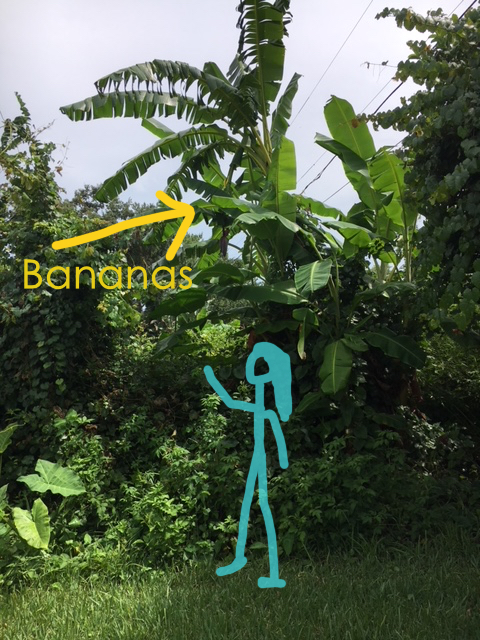
Although the banana trees in the back corner of the yard were frozen this winter, they have come back and grown very tall.  In fact, one of them recently put off a shoot of bananas!

banana tree height
Height of tree and bunch of fruit – I am 5’5″ and can’t come close to reaching it. (That’s me in blue LOL)

I’ve had banana trees bear fruit before, but the bananas were never very good. Maybe we didn’t wait long enough to pick them. The only bananas I know about are the ones sitting on the grocery store end caps. So maybe it’s time to learn about those wild bunches of bananas.

How to Grow and Harvest Bananas – I Just Learned This!

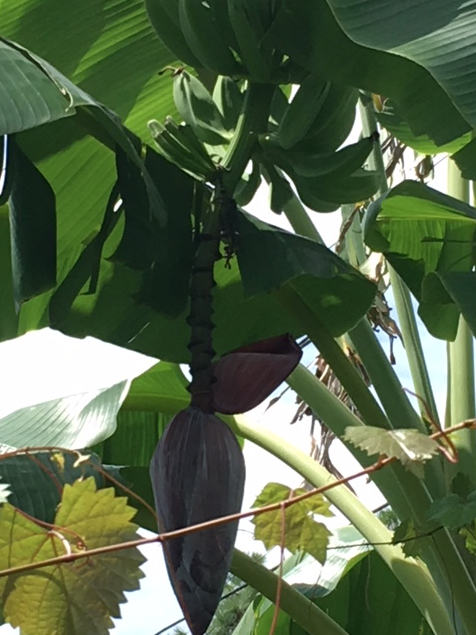
All those little bumps along the stem above the bulb on the end (photo below) will become bananas!  This plant is just getting started.  The Dole video below mentions waiting 12-13 weeks after the bananas begin to grow before harvesting.  They cut theirs while they are green.

As the bananas fill in along that stem, they will get heavy (60 plus pounds!) and some trees need propping up. I don’t think I will be able to do that.  This tree, and other little ones around it, are in the bushes next to my yard and not in a “garden” area.  This bunch of bananas is on a tree that must be 15 feet tall (photo above).  Since I took this photo, the branch has elongated so more bananas can form along the stem.

bananas on tree
Bananas on the tree

First, I want to say that I did not plant those banana trees. The house behind mine has a big garden area and they do have banana plants in their yard.  I’m guessing that the banana trees now growing on this side of their fence came from their yard. I have no idea what type of banana trees they are.

The University of Florida Gardening Solutions page says that because of sandy soil bananas need to be fertilized. No one has fertilized “my” banana trees.

Something I have learned is that once a tree produces bananas it is done. It will not produce any more. That is why bananas have off-shoots, or baby banana trees growing near the large one. The little ones will grow and do the same thing as the “mother” tree.

Growing Bananas Videos

In my search for growing bananas information I came across a couple of cool videos. The first one is nearly 30 minutes long and the grower is growing (and eating) “ice cream” bananas.

He makes a mistake by cutting of the 60 pound bunch of bananas thinking he can hold it in one hand – and drops it! Then, according to the comments below the video, he hangs the bunch the wrong way – I don’t know about that. Some viewers also left comments that cutting down the main tree is not necessary.

In the second video, which is about the Dole company and how they grow bananas, all the workers do is chop the leaves off the main plant and leave them on the ground to provide nutrients. They do not cut down the whole tree.

Dole company video – which I found to be interesting.

Potential Problems With Growing Bananas

A healthy banana tree can add interest to the yard, but when they turn brown, or begin to die and fall over, not so much.

Plant in an area where there is space for more “baby” plants to spring up. None of those banana trees in my photo were planted. They sprung up on their own.

The hurricanes – we’ve had two major ones come through within the two years I’ve lived in this house – the wind shredded the leaves of the trees to bits.

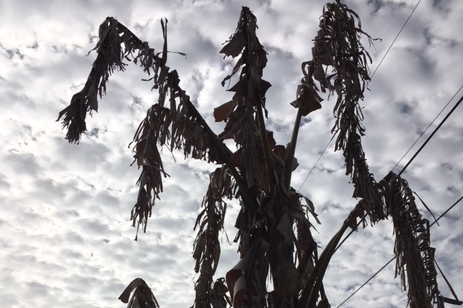
Then we had some very cold nights over the past winter which turned the trees brown.

Yet, here we are with very tall, lovely trees less than a year later, and one is growing bananas already. The trees bounce back quickly in this hot, tropical climate, but they can die way down.

dead brown leaves plants after freeze
The same tree in winter this past year

Finally, Growing Tomatoes Advice For the Florida Climate

As I was searching for some other gardening advice altogether, I came across a Florida gardening blogger who seems to have very useful information to share. Unfortunately it looks as if his blogging stopped a few years ago in 2015. Maybe he moved away to a better place.

I found a post with growing tomatoes advice which would explain why I have such a difficult time with tomatoes.

First of all he starts with seeds (Plant Your Tomato Seeds). I’ve been wondering if the fact that I buy seedlings from Home Depot (there is nowhere else I’ve found) is my biggest problem. He says store bought plants “are never very good”. I already suspected this.

Start planting seeds early enough to have seedlings ready for the garden by March first. He says to buy a combination of sizes, but tomatoes won’t grow very large in this climate. I’ve found that to be true as well. I don’t have the space for a lot of plants, but I can use my fabric bags.

Which Tomato Seeds to Buy?

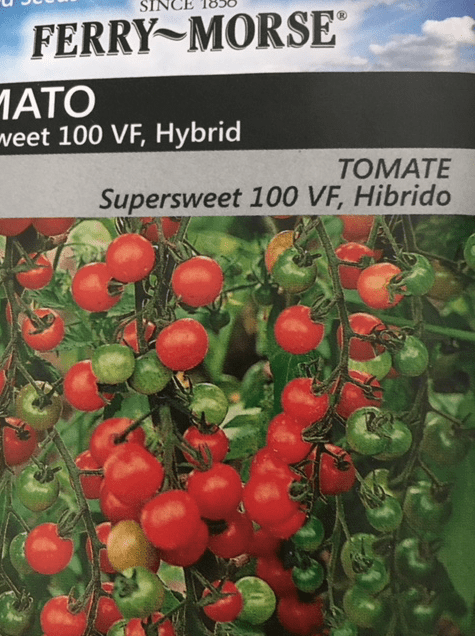
The blogger I am referencing plants Hybrid Tomatoes only.  I am not sure why, except that they are probably tougher than heirlooms.  A hybrid is a cross-pollinated plant.  The characteristics are better yield and disease resistance, among others.

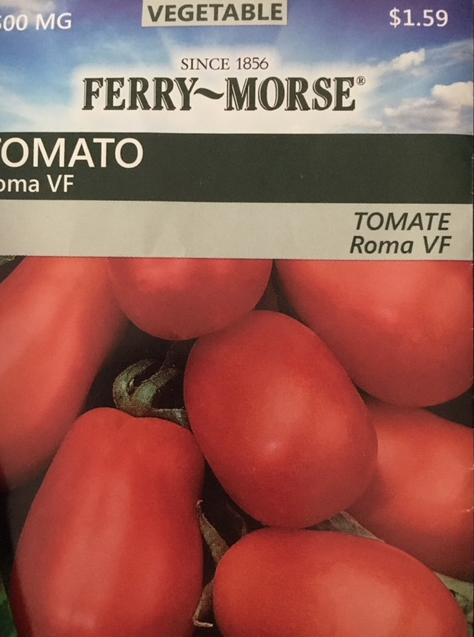
Roma tomato seed packet

In case you are interested in buying tomato seeds online:  Organic Heirloom tomato seeds can be purchased at the Tomato Fest site. These are NOT hybrids. Heirloom tomatoes give the grower the option to save seeds to plant the following year. You can’t do that with hybrids.

Buy the most disease and pest resistant varieties. Look at package labeling for letters that follow the name of the tomato. See the key list of what that lettering means on this page at Gurneys.  My packet above contains the letters VF which protects from wilt disease.

Indeterminates only – this means the tomatoes will continue to grow shooting out stems and growing tall all during the growing season. Indeterminates continue to set fruit while you pick ripe tomatoes. In other words, they just keep growing until something stops them. They need staking, whereas determinate varieties are more compact and can grow in pots.
**Note here: Indeterminates can grow to be 12 feet tall! I will need to re-think my staking. I suspect that in Florida they could easily grow to astounding heights.  I can see the raccoons climbing my stakes and destroying my crops.

Pick Tomatoes Early

Letting tomatoes ripen on the vine is my preference, but the raccoons tend to pick them before I get to.  My reference blogger picks his early and says they taste better when he lets them ripen indoors.  His blog is helpful, but not easy to navigate, so use the “search” area.

He mentions planting some tomatoes later in the season, in the shade, in a new area, and they did well.  Read about that at the bottom of this page where he “answers a question“.

I’m grateful for this info.

Caladiums and Impatiens Flower Garden Under the Trees

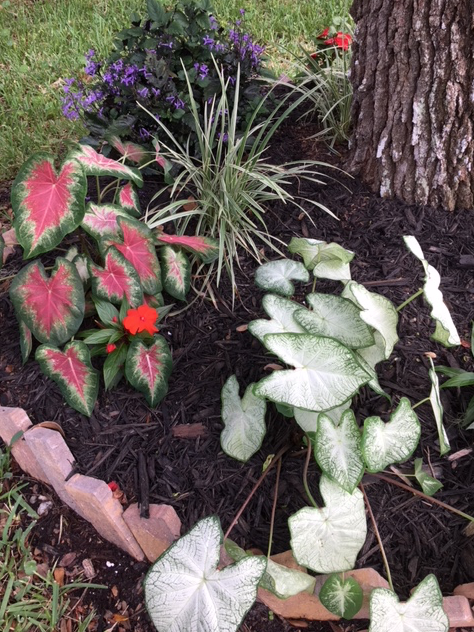
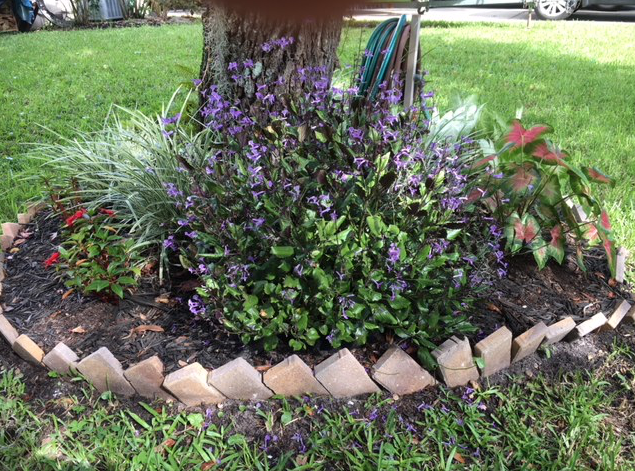
When I bought my house nearly 2 years ago, there was a little flower garden under the trees out front.  I neglected it and it became overgrown very quickly.  I’m not inclined to work outside in the heat, but the other day I decided a quick fix was in order.  The garden is small, so the work would be minimal.  We had brick pavers leftover from the building of the patio, so I used them to create a new border to hold the additional dirt needed.

I’m not yet very good with my Florida plant names, but the ones with the colorful, pointed leaves are Caladium.  The link to Eden Brothers calls them “bulbs”.  Mine came out of a pot so didn’t look like bulbs to me.

The white leaves are called “Florida Moonlight”.  I don’t know the name of the pink-leafed one, but they add lots of interest in the yard.  They love heat and humidity, which explains why they do so well here.

Flower garden under the trees

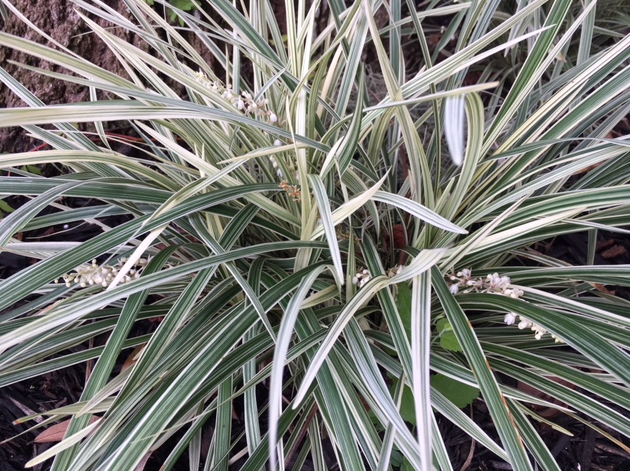
Also in the background around the tree are the thin leaves of the Variegated Flax Lily.  I spent a lot of time removing lots of dead leaves from them.  Even without attention they continued to grow, so I would say they are very hardy plants.  Now that I have given them some attention, the lily is blooming.  Each plant has tiny white flowers on stalks among the leaves.

little white flowers
Little stalks of white flowers on the Varigated Lily

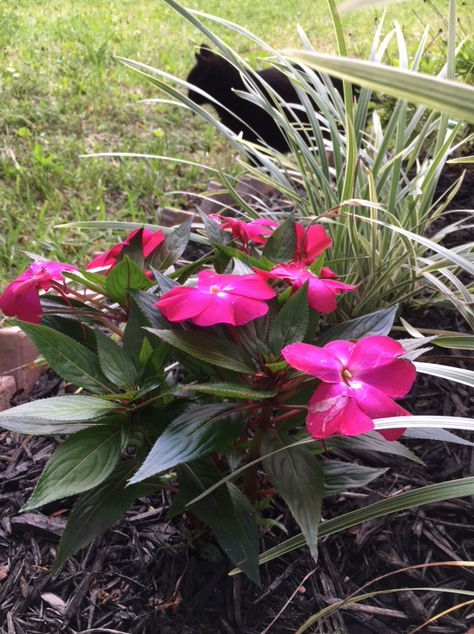
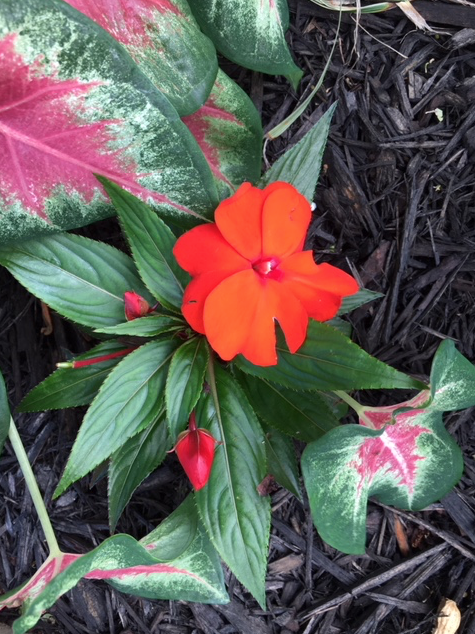
When I first moved in here I bought a bunch of New Guinea Impatiens and put them in the garden by the front door.   The brightly colored flowers add continuous color to the landscape.  It turned out those annuals lasted nearly a year. The very cold nights in January finally froze most of them. Because they did so well, I bought a few more to put under the tree.

New Guinea Impatien
New Guinea Impatien and Caladium leaves

University of Florida plants list for the shade.

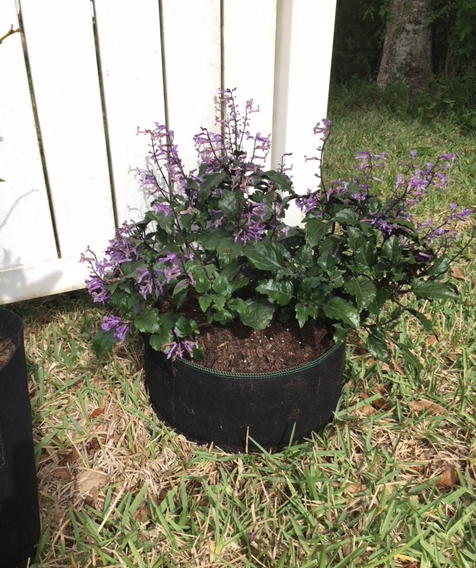
The purple flowering plant which is now under the tree is still in the short fabric pot. It is a Mona Lavender Plectranthus. I bought it because it was pretty, and I especially love the deep green of the leaves.

Now that I am researching this plant, I have discovered it needs some shade and is a perennial in warm climates. It seems that I have chosen a good spot for it to grow under the tree.  I moved the fabric pot and did not dig up this plant.  The potted Mona Lavender is now part of the shade garden and no one can tell it’s in a pot!

short grow bag
Plectranthus, Mona Lavender

Because planting around the base of a tree can be difficult because of roots, fabric gardening pots can be super helpful.

shade garden
The purple flowering plant is in a fabric pot.

All my new plants were purchased at the Home Depot. I also bought more organic garden dirt, and added blood meal and black mulch.

In my part of central Florida, plants can be killed in winter.  When freezing temperatures are coming overnight I will have to cover all these plants to keep them from dying.

Pepper Plant Beasts Among the Greenery

One of my favorite garden plants is the bell pepper I planted over a year ago. Apparently here in Florida vegetable plants just go on and on. The pepper survived some pretty cold nights (below freezing temps) over the winter, and has come back stronger than ever.

Besides giving me some nice juicy peppers to eat, it is home to some special “beasts” that are common to this area.

I see lizards all the time scampering around my garden. Skittle the cat catches them, but seldom kills them. She simply likes to play with them. Often I see them without tails (which grow back) and figure they lost it when Skittle pounced.

This one is a brown anole, and I see them much more often than the green anole. After reading the Wikipedia article, I guess I know why.  The brown one is an invasive species and eats the green one!!  This thing really is a beast.  It used to be that all I ever saw were the green lizards, but come to think of it, I don’t see them any more.  I don’t see many green tree frogs either, so what has happened to those?

Florida is always changing, and usually NOT for the better.

lizard on the green pepper leaf

There is a tree frog that seems to change sleeping spots from the garden to the umbrella to the hose holder. Is it the same frog? I only ever seem to see one at a time. Usually he sits on the bars beneath my table umbrella. The other day he spent the whole day tucked between the hose rolls on the garden hose holder. Each time I watered I was careful not to squish him.

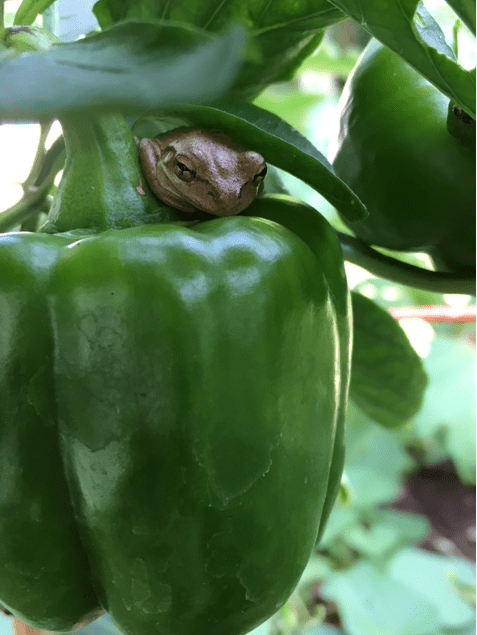
As I was checking out my peppers the other day, there he was. Tucked in under a leaf and sitting on top of a big pepper.  I think he is a Pine Woods Tree Frog.  But it could be the Cuban Tree Frog… hope not.  I’ll have to get a better look at him.

tree frog pepper plant
Tree frog napping on my pepper

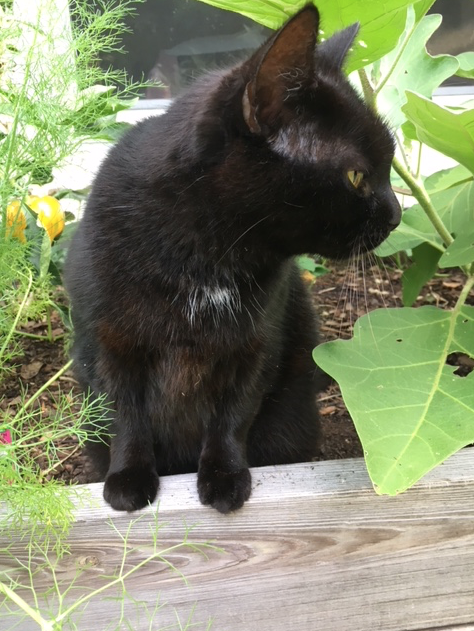
Skittle the Cat is not hanging out on the pepper plant, but she has always loved snooping through the greenery of a garden. Her happy place these days is sleeping beneath the big leaves of the eggplant. It’s where she takes her cat naps between hunting lizards and getting into other mischief.

Skittle the Cat
Skittle the Cat

Air Plants Need Only a Branch to Grow

No dirt needed.  Air plants seem to be just that – plants that grow in air. This is one of the coolest plants that grow in Florida.  It is a type of bromeliad.

You may see air plants in the wild way up on the branches of oak trees. Or sometimes they grow off the side of the tree or closer to the ground.

air plant
Air plant down inside my Schefflera plant

Yesterday I happened to spot a small clump of air plants down inside my Schefflera.  I thought it may have attached itself to the branch and wanted to get a photo.  As I began picking the dead leaves off the plant, I realized it was not attached.  It had fallen out of the nearby oak and lodged itself in the Schefflera.

I’m not sure which type of bromeliad this is.  Could be the leatherleaf or broad needleleaf type.  Below is a picture of the dried flower attached to the plant.

air plant flower
Air plant dried flower

The roots are used to attach itself to the host tree, which in this case would have been one of the tall oaks in my yard. The shape of the leaves funnel water, insects and other things down into a “tank” where minerals are absorbed to feed the plant. There is no need for dirt and this is why they can attach to a limb and exist happily there.

roots of air plant
Roots of air plant

There is still a small oak branch which runs through this air plant. It must have broken off the tree in high winds and sent this air plant to the ground.

air plant
See the little oak branch?

After Hurricane Irma I found a large air plant in the yard. I picked it up and put it in the low branches of a shrub. I hoped it would be okay, but the leaves began to fall off and eventually the whole thing fell apart. It was too damaged to survive, or didn’t have the right stuff to live.  Maybe I should have set it some place else.  It was beautiful.

I believe this one is called the “Giant Air Plant” according to the UF site (link below).  It is now endangered thanks to the infiltration of the Mexican bromeliad weevil (and possibly hurricanes.)

giant air plant
Giant Air Plant blown from a tree during hurricane

Unfortunately people seem to think they should collect them as souvenirs. Also, with all the land clearing and building that goes on here, their natural habitats (trees) are being destroyed. Between that and the Mexican bromeliad weevil, which kills the plants, 10 of Florida’s 16 native bromeliad species is threatened or endangered.  This is according to the University of Florida which has a page about Florida’s Native Bromeliads. Visit the page to see photos of the many different types found in the state.
The photo below shows a unique way to display a bromeliad and tropical plant collection in the yard.

old car used as plant stand
Photo credit: Pixabay

Brazilian Pepper Invasive Florida Plant

At the edge of my property a stand of trees, with winding branches and dark green leaves makes the perfect hideout for wildlife. I did think they were Dahoon Holly trees, but I was mistaken. They are invasive Brazilian pepper trees and have become a problem for Floridians.

backyard
Trees with red berries

This thick area of trees and shrubs is where the raccoons come from each night. It’s also where the zillions of stray cats walk as they pass through the yard.
I don’t know if the birds knew I wanted photos today, but they showed up in droves.  Unfortunately I am not such a good wildlife photographer!  I saw a bunch of grosbeaks gathered on a berry laden branch, and got this photo of a robin (center of picture) – not a good photo, I know.  In fact, the many birds have nearly eaten all the berries!

Even as the berries give the birds food, it is also what helps to spread the growth of these trees.  The birds spread the seeds.

So how to tell the difference between trees that have clumps of red berries?  The Brazilian Pepper has 9 leaves and the leaves are dark green.  The Dahoon Holly’s leaves are more true green and are fewer.  At least, from photos I’ve seen, that looks like the difference.  Also the pepper has that tangled mass of trunks, whereas the holly grows more like a regular tree.

Robin

The trunk can actually be split into many trunks, like in my photo below.

tree trunk
Mass of tree trunks

tree with red berries
Red berries

red berries of Brazilian pepper
Brazilian Pepper

branches, thicket underbrush
The thick growth prevents other plants from growing.

Screen Shot 2018-02-21 at 6.22.02 PM
Indian River at Edgewater, Florida