No dirt needed. Air plants seem to be just that – plants that grow in air. This is one of the coolest plants that grow in Florida. It is a type of bromeliad.
You may see air plants in the wild way up on the branches of oak trees. Or sometimes they grow off the side of the tree or closer to the ground.
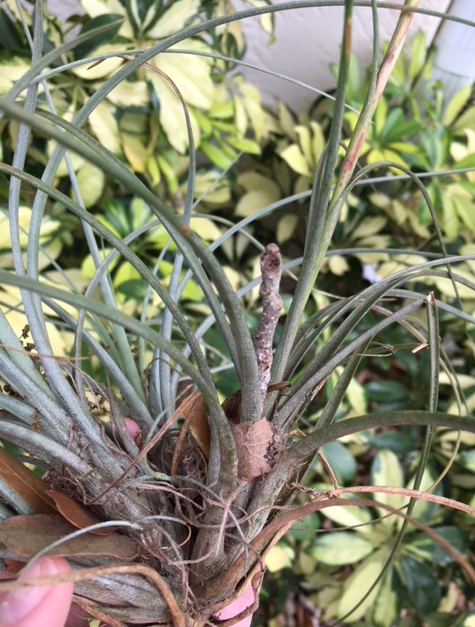
Air plant down inside my Schefflera plant
Yesterday I happened to spot a small clump of air plants down inside my Schefflera. I thought it may have attached itself to the branch and wanted to get a photo. As I began picking the dead leaves off the plant, I realized it was not attached. It had fallen out of the nearby oak and lodged itself in the Schefflera.
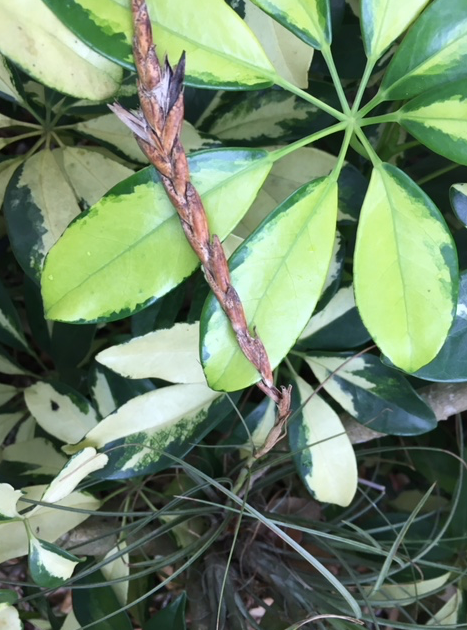
I’m not sure which type of bromeliad this is. Could be the leatherleaf or broad needleleaf type. Below is a picture of the dried flower attached to the plant.
Air plant dried flower
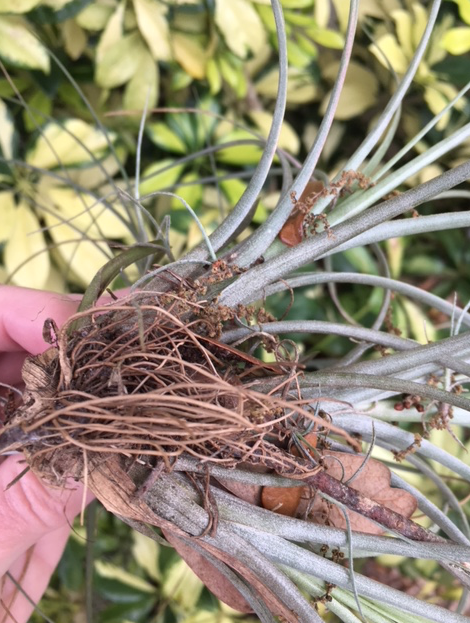
The roots are used to attach itself to the host tree, which in this case would have been one of the tall oaks in my yard. The shape of the leaves funnel water, insects and other things down into a “tank” where minerals are absorbed to feed the plant. There is no need for dirt and this is why they can attach to a limb and exist happily there.
Roots of air plant
There is still a small oak branch which runs through this air plant. It must have broken off the tree in high winds and sent this air plant to the ground.
See the little oak branch?
After Hurricane Irma I found a large air plant in the yard. I picked it up and put it in the low branches of a shrub. I hoped it would be okay, but the leaves began to fall off and eventually the whole thing fell apart. It was too damaged to survive, or didn’t have the right stuff to live. Maybe I should have set it some place else. It was beautiful.
I believe this one is called the “Giant Air Plant” according to the UF site (link below). It is now endangered thanks to the infiltration of the Mexican bromeliad weevil (and possibly hurricanes.)
Giant Air Plant blown from a tree during hurricane
Unfortunately people seem to think they should collect them as souvenirs. Also, with all the land clearing and building that goes on here, their natural habitats (trees) are being destroyed. Between that and the Mexican bromeliad weevil, which kills the plants, 10 of Florida’s 16 native bromeliad species is threatened or endangered. This is according to the University of Florida which has a page about Florida’s Native Bromeliads. Visit the page to see photos of the many different types found in the state.
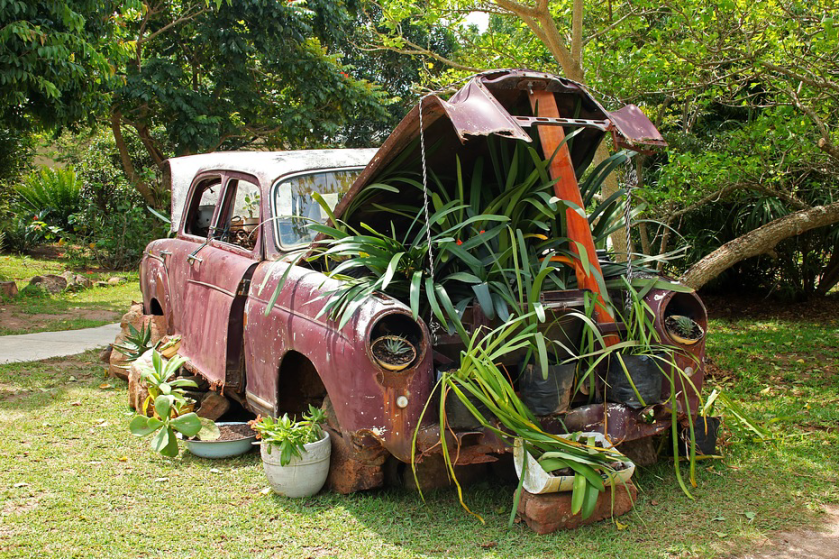
The photo below shows a unique way to display a bromeliad and tropical plant collection in the yard.
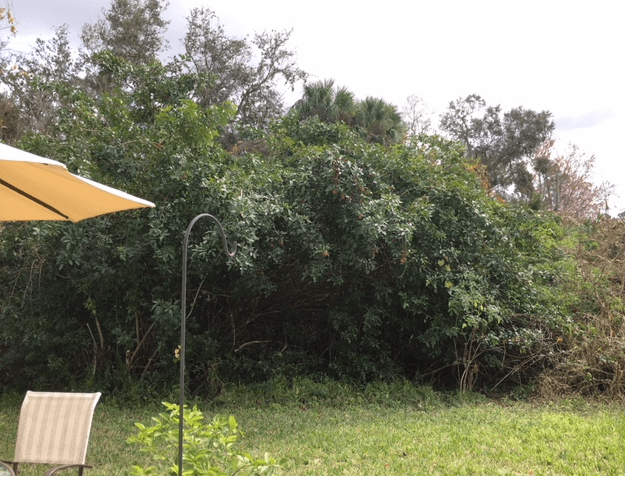
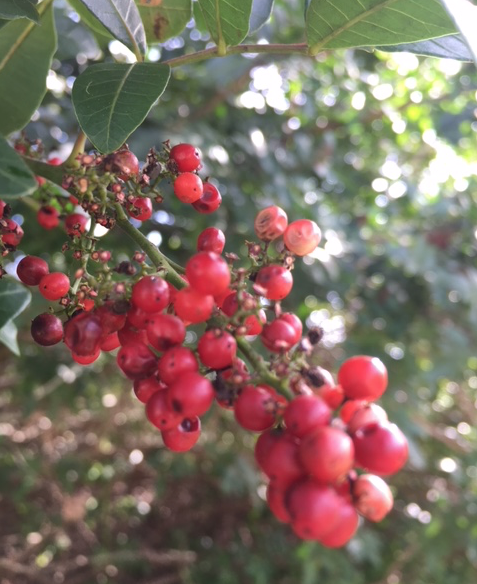
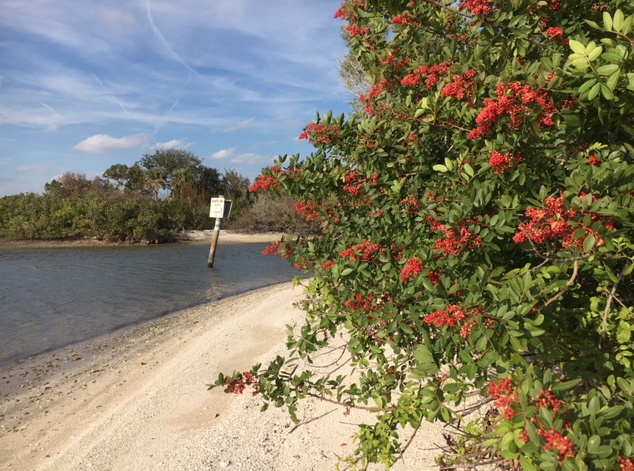
At the edge of my property a stand of trees, with winding branches and dark green leaves makes the perfect hideout for wildlife. I did think they were Dahoon Holly trees, but I was mistaken. They are invasive Brazilian pepper trees and have become a problem for Floridians.
Trees with red berries
This thick area of trees and shrubs is where the raccoons come from each night. It’s also where the zillions of stray cats walk as they pass through the yard.
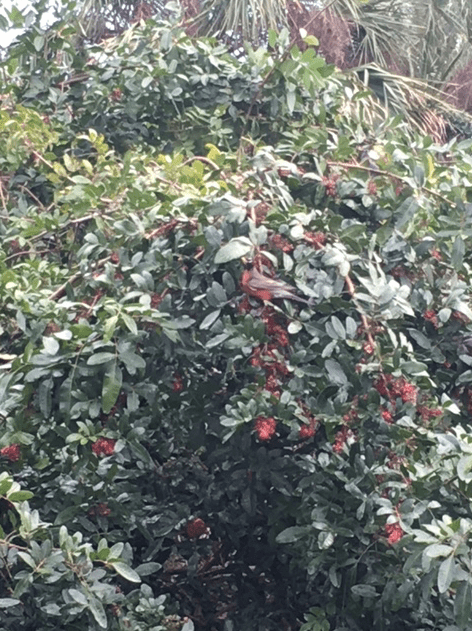
I don’t know if the birds knew I wanted photos today, but they showed up in droves. Unfortunately I am not such a good wildlife photographer! I saw a bunch of grosbeaks gathered on a berry laden branch, and got this photo of a robin (center of picture) – not a good photo, I know. In fact, the many birds have nearly eaten all the berries!
Even as the berries give the birds food, it is also what helps to spread the growth of these trees. The birds spread the seeds.
So how to tell the difference between trees that have clumps of red berries? The Brazilian Pepper has 9 leaves and the leaves are dark green. The Dahoon Holly’s leaves are more true green and are fewer. At least, from photos I’ve seen, that looks like the difference. Also the pepper has that tangled mass of trunks, whereas the holly grows more like a regular tree.
Robin
The trunk can actually be split into many trunks, like in my photo below.
Mass of tree trunksRed berriesBrazilian PepperThe thick growth prevents other plants from growing.
A week or go ago here in central Florida we had about three nights in a row where temperatures got into the twenties. Tropical plants do not like a Florida freeze.
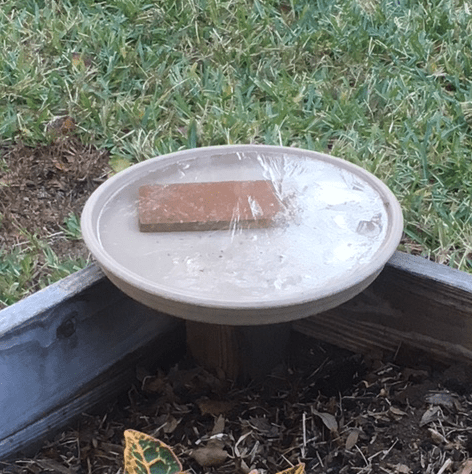
They can handle a short stretch of cold, but not the constant, ongoing cold. One day I went out to dump out the ice in the bird bath and filled it with new water – which froze over again. That is unusual. Daytime brings warmer temperatures, but not that day. It was too much for plants which love sun and heat.
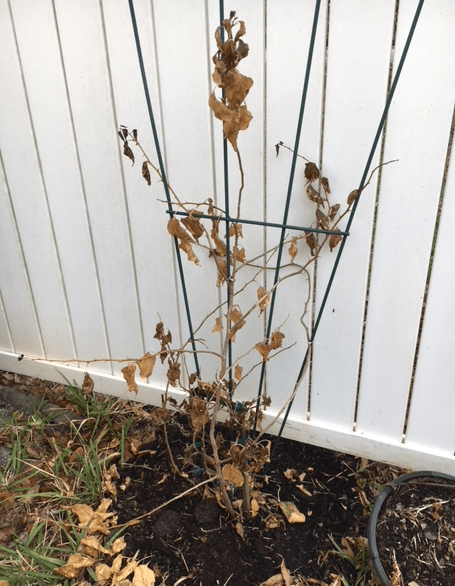
The saddest example of death in the yard is my beautiful croton. I have a few “baby plants” started from it and they have survived the cold. If I have to I can replant.
This was a beautiful croton and hibiscus
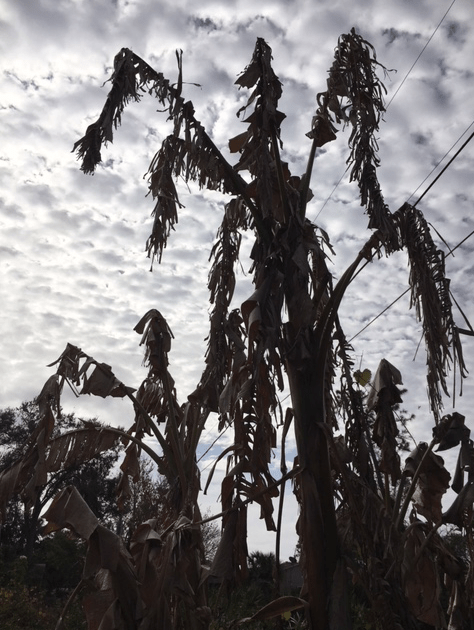
These banana trees sprung up at the edge of my yard and I’ve watched them grow for the past year. I think the house behind me threw some old banana trees over into the woods and they simply grew. They were getting tall and looking good and then the hurricane hit. The wind shredded the long leaves on the banana tree. Now we’ve had cold which has turned all the shredded leaves brown. Poor thing doesn’t look too good now.
Banana Trees
The New Guinea impatiens that have been growing in the front garden – and survived throughout last winter – are brown and wilted.
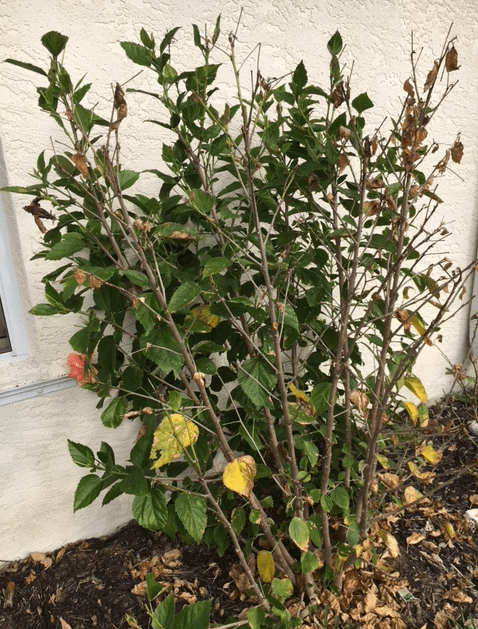
My hibiscus is planted right next to the house, which usually helps when cold temps set in. I also covered it on two of the really cold nights. That didn’t keep the entire front part of it from turning brown.
Front part of hibiscus is brown and dead
The bougainvillea which had just recently begun to grow larger is now a spindly brown vine.
First my eggplant died along the top. I covered it, and that didn’t seem to do much good. After the second night of low temps the rest of the plant turned brown. I’m not too sad because it has given me only one eggplant. That’s it in the background of the picture below.
Eggplant is dead, but pepper lives on for now
I always believed that pepper plants loved heat, but this bell pepper plant is still nice and green when everything else has mostly died. I don’t know if it will continue to grow, but I hope so. I had been getting small green peppers from it fairly regularly.
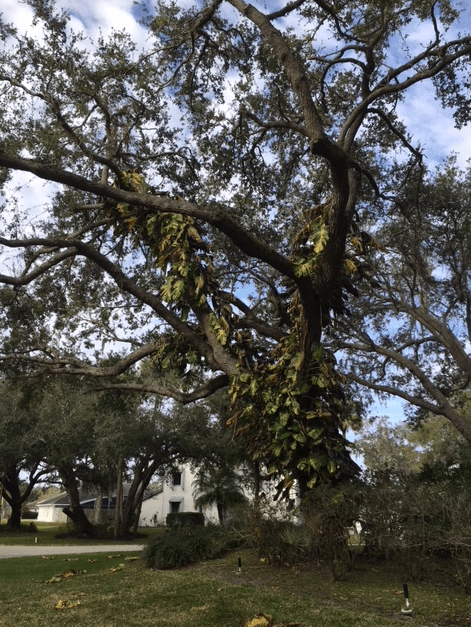
I took a walk around my neighborhood the other morning and got this photo of an oak tree with a huge vine crawling up through the branches. I’d seen it before, but noticed this time that many of the big tropical leaves were brown.
Vine of big leaves growing up an oak tree
It is possible that these plants will come back. If the roots have not been killed, green will show up once again. The eggplant already has some little green leaves sprouting at the base of the plant.
I found a “Cold Hardy Plant List” for central Florida on the Central Florida Gardener site. I’ll have to look into it further when I decide to upgrade my landscape.
We have had some cold weather here in Florida recently and I guess it’s so we don’t feel left out this winter. With temps in the minus 20’s back in New England, I won’t get any pity for the cold I deal with in Florida. But for us here in the south, ice is not so common.
It felt like 22 degrees overnight for three nights in a row and that has done some damage to plantings.
My eggplant stalks are now dead at the top and it looks like the poinsettia is totally dead. I could have gone out and covered the plants each night, but I just didn’t care enough to do so.
Frozen top of eggplant
This plant has grown like mad but given me only one eggplant to eat. I am not so sure I want this plant taking over my tiny garden area without giving me any vegetables to eat.
Winter is only beginning and if I want to save my outdoor plants they will have to be covered every time the temps drop below freezing. I have sheets and towels ready to use for covering, but I don’t have anything that important to save. Only my lime tree is worth the trouble and I can bring it indoors on cold nights, which I did.
The birdbath iced over for three nights and my cat, Skittle, was confused as to why she couldn’t drink from it. I took a short video with my iPhone which you can see below.
The photo below is of my orange hibiscus and rose bush after planting in my yard. This past April, 2017, I dug up a little patch of grass in the back yard to create a space for a colorful flower garden.
The pretty double-flower orange hibiscus is a typical plant to grow in Florida. I prefer the double type flower, and I thought the color was lovely. You can see that it was a small plant.
New Garden, Hibiscus and Rose Bush – April 2017
Roses are such a bother, but this one was pretty and I decided to try it. The rose bush looks awful now, but the hibiscus has grown like crazy. This just goes to show that if you plant what likes to grow in the local climate it will flourish.
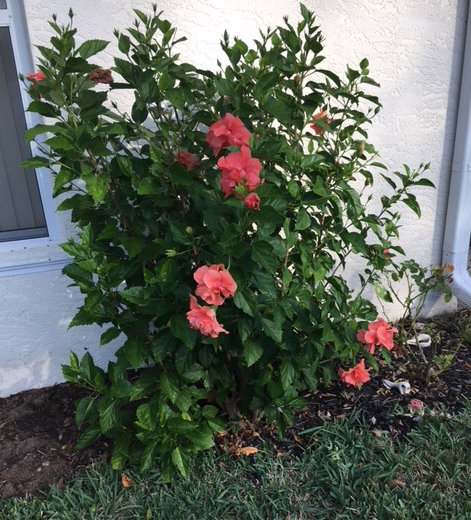
Here it is 7 months later.
Hibiscus and Rose Bush in November 2017
The hibiscus plant was watered regularly after it was planted, as was the rose. There were some mites on the buds, so I picked off the buds and threw them away. I’ve noticed that sometimes there are still mites on the plant, but it is not affecting the growth. I never water it now and it is flourishing in the sunny spot by the house.
Hibiscus are tropical plants and I fully expected it to survive quite well. I didn’t realize it would grow so fast. It constantly buds and blooms and the leaves are nice and green.
All I do is occasionally pick off the bug infested buds and give it fish fertilizer and sprinkle some bone meal around the base for good root strength.
I have plans to plant more like this in the front yard. The wind blows from the front and it’s also more shady, so I don’t know if that will be a good location.
Something I’ve always enjoyed is watching my plants grow and change. I once took photos of the Pinky Winky hydrangea in my New Hampshire yard for an entire blooming season to show the changes in the flowers from summer through fall.
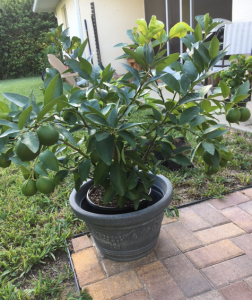
Gardening and growing things here in Florida is an ongoing learning process for me. Last November I bought a Persian lime tree and a Meyer lemon tree to put in my yard. I knew nothing about growing either type of tree but I hoped to pick fresh fruit one day.
That day has arrived! So here’s what I have learned from growing a lime tree. And it’s good news for anyone considering growing a lime tree in a pot. (The lemon tree isn’t doing so well, but I’ll get to that later.)
Flowers to Fruit Timeline
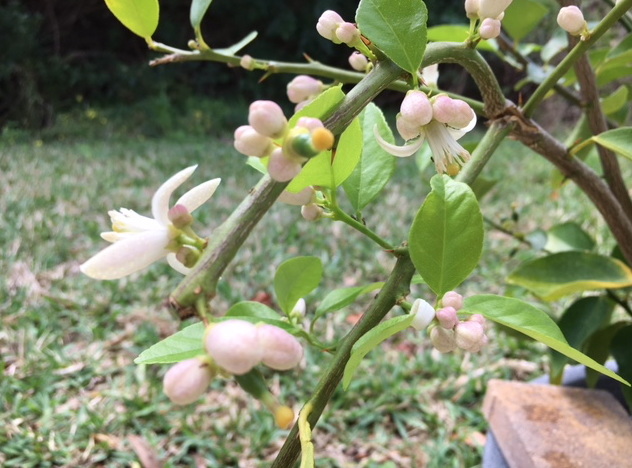
Buds and flowers begin showing up in December and continue to flower and set fruit into February.
Buds and flowers on the Lime tree in February
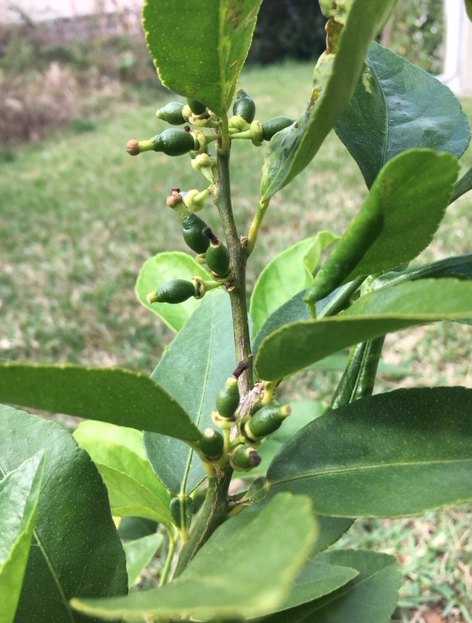
There are buds, flowers and little limes on the tree at the same time. I even have one lone big lime still hanging on from the previous Fall.
Setting fruit – little limes on the tree in February
By October the limes should be ready to eat. They will last for a couple of months, and I pick them as needed so they are nice and fresh – and delicious!
Once the fruit is gone, the buds begin again. So the tree is always doing something.
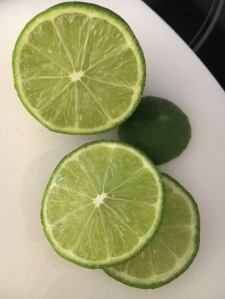
My first lime!
A few days ago I picked my first lime! I sliced it and put it into my glass of water… and boy was it good! I love limes… what awesome flavor. I had really been hoping for lemons, but I think I like limes more. It reminded me of the Mojitos I’ve had – but without the booze. The lime I picked was small, but juicy. I won’t go nuts picking all the fruit, but I will definitely be using the larger limes.
I had wondered when to pick my limes and I simply waited for them to be the size of the ones I see at the grocery store. The time from flowering to picking was about 6 months. It is so worth the wait!
Benefits of Growing Limes in a Pot
I kept the lime tree in it’s pot and set it on the corner of the patio in my backyard. I have read that these smaller citrus trees can be grown in pots. In fact they can be purchased through Amazon. This is something I never knew, and the buyers leave very good reviews. They won’t ship to some areas – like the places that can grow and sell their own trees, it seems. Florida is one.
One of the big advantages of growing in pots is the ability to move the plant / tree. Over winter it did get very cold one or two nights and I brought the tree inside. The Persian Lime tree is hardy to zone 10 and I am in zone 9b – a little too far north. When the temps get at, or below, freezing it needs to be covered or moved inside.
Besides the fact that a lime tree can do well and bear fruit while still in it’s original pot, I’ve learned that being in a pot means the fruit-laden branches won’t hit the ground.
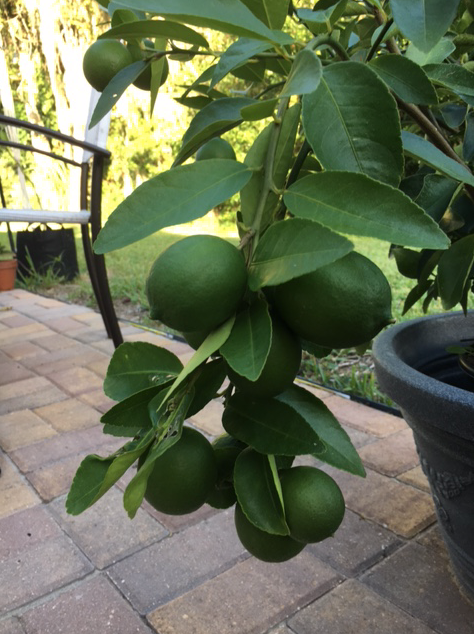
This is the trouble I am having with the lemon tree. Once the heavy fruit began to grow, the branches drooped considerably. As you can see in my photo, many limes are growing in a cluster at the end of this branch which weighs it down.
If this tree was in the ground, this branch would be rubbing along the dirt – and in danger of being hit by the mower or weed-eater.
Cluster of Limes
The Lemon Tree is Not Very Pretty
Shortly after I planted the lemon tree in the ground, I realized that my dream of having a row of citrus trees along the front of the house was unrealistic. The north wind blows from that direction and it can get very windy some days. I’m not saying it’s cold, I am in Florida, but the constant wind on the Lemon tree has been detrimental to it’s growth. Between that and being hit by my son’s weed-eating job, the poor lemon tree is having a hard time. I also think something may be eating the branches. I may not have any edible lemons.
*Update, I recently dug up the lemon tree and it’s now growing in a pot out back near the lime.
How to Care for Citrus Trees
Both trees receive citrus fertilizer every few months, except in winter. Fertilizing stops in November and begins again in March. This is according to the pamphlet I got at the plant nursery.
Here in Florida, if it doesn’t rain, everything needs to be watered daily in summer. I usually water the Lime tree twice a day. Being in a pot, out in the sun, means it will dry out faster. This changes in winter, when it needs less water. The leaves began to turn yellow and fall off because I watered it too much. Watering every few days in winter (Florida) is fine.
I did have to set the potted tree inside a larger plastic pot and weigh it down with leftover bricks from building our patio. I had to do this because once the fruit began to grow the tree was top heavy and would blow over whenever the soil dried out.
In a Nutshell
I bought my Persian Lime tree in November 2016 from a local nursery for $12.99. It immediately began to grow longer stems and more leaves. Maybe it was the direct sunlight compared to the nursery conditions, but the tree doubled in size!
A few months later it began to flower profusely and set many limes. Lots of those fell off, leaving the larger ones to continue to grow. Don’t worry if lots of the small limes fall from the tree. The tree seems to know just how many limes it can handle! Many will stay and continue to grow.
I picked one lime, and there are 28 limes left on the branches (I just went out and counted them). I see a few very tiny limes growing also, but they may fall off. Not a bad first harvest!